Photography/social media feed back wanted

I love taking pictures! My memory is fading so I have my pictures to trigger a memory both good and bad. You can see them all on Instagram I feel like my pictures are gaining more popularity then my posts. I am trying to post more. I did 3 posts here today. YAY!! I have so much to talk about. I feel like I am not posting good content. In less than a month I’ve gained quite a following and I love and appreciate everyone of you but I feel like there is more I could be doing to make it better. I’ve put so much pressure on myself to post repeats everyday I even have a list of topics but I’m not living up to the potential and gift I have.

I know my mind is slowly going. We’ve done the test and proven it but I’m trying to push through it and make something out of it to either help improve my memory or a legacy when it goes completely. This is my gateway for my book. I love my book. It is my escape from reality.

This is a short post but I want your opinions. What are you thinking should I revamp this early in the game?

Instagram: Bipolaroutcasts

Facebook: Will it Reach you on time

Day 7 Schizophrenia

Each day I will detail an illness. Some of them you’ve heard of some you haven’t but the most important thing is we recognize some of them. One illness is greater than the other just some for more information.

Schizophrenia Overview

Schizophrenia symptoms include distorted thoughts, hallucinations, and feelings of fright and paranoia. Psychiatrists evaluate symptoms, tests, and medical history, and prescribe medications and psychotherapy for treatment.

TOP SEARCH TERMS FOR SCHIZOPHRENIA

Paranoid Schizophrenia

Schizoaffective Disorder

Tardive Dyskinesia

Schizophrenia Symptoms

Delusional Disorder

Psychosis

Schizophrenia Test

Schizophrenia Causes

Schizophrenia Medication

Psychotic Disorders

Brief Psychotic Disorder

Schizophreniform Disorder

Schizophrenia is a serious brain disorder that distorts the way a person thinks, acts, expresses emotions, perceives reality, and relates to others. People with schizophrenia — the most chronic and disabling of the major mental illnesses — often have problems functioning in society, at work, at school, and in relationships. Schizophrenia can leave its sufferer frightened and withdrawn. It is a life-long disease that cannot be cured but can be controlled with proper treatment.

Contrary to popular belief, schizophrenia is not a split or multiple personality. Schizophrenia is a psychosis, a type of mental illness in which a person cannot tell what is real from what is imagined. At times, people with psychotic disorders lose touch with reality. The world may seem like a jumble of confusing thoughts, images, and sounds. The behavior of people with schizophrenia may be very strange and even shocking. A sudden change in personality and behavior, which occurs when schizophrenia sufferers lose touch with reality, is called a psychotic episode.

Schizophrenia varies in severity from person to person. Some people have only one psychotic episode while others have many episodes during a lifetime but lead relatively normal lives between episodes. Still other individuals with this disorder may experience a decline in their functioning over time with little improvement between full blown psychotic episodes. Schizophrenia symptoms seem to worsen and improve in cycles known as relapses and remissions.

What Are the Symptoms of Schizophrenia?

People with schizophrenia may have a number of symptoms involving changes in functioning, thinking, perception, behavior, and personality, and they may display different kinds of behavior at different times.

It is a long term mental illness which usually shows its first signs in men in their late teens or early 20s, while in women, it tends to be in their early 20s and 30s. The period when symptoms first start to arise and before the onset of full psychosis is called the prodromal period. It can last days, weeks or even years. Sometime it can be difficult to recognize because there is usually no specific trigger. A prodrome is accompanied by what can be perceived as subtle behavioral changes, especially in teens. This includes a change in grades, social withdrawal, trouble concentrating, temper flares, or difficulty sleeping. The most common symptoms of schizophrenia can be grouped into several categories including positive symptoms, cognitive symptoms, and negative symptoms.

Positive Symptoms of Schizophrenia

In this case, the word positive does not mean “good.” Rather, it refers to symptoms added in to one’s experience that are exaggerated and irrational forms of thinking or behavior. These symptoms are not based in reality and are sometimes referred to as psychotic symptoms, such as:

• Delusions: Delusions are strange beliefs that are not based in reality and that the person refuses to give up, even when presented with factual information. For example, the person suffering from delusions may believe that people can hear his or her thoughts, that he or she is God or the devil, or that people are putting thoughts into his or her head or plotting against them.

• Hallucinations: These involve perceiving sensations that aren’t real. Hearing voices is the most common hallucination in people with schizophrenia. The voices may comment on the person’s behavior, insult the person, or give commands. Other types of hallucinations are rare such as seeing things that aren’t there, smelling strange odors, having a “funny” taste in your mouth, and feeling sensations on your skin even though nothing is touching your body.

• Catatonia (a condition in which the person becomes physically fixed in a single position for a very long time).

Disorganized symptoms of schizophrenia are a type of positive symptom that reflects that person’s inability to think clearly and respond appropriately. Examples of disorganized symptoms include:

• Talking in sentences that do not make sense or using nonsense words, making it difficult for the person to communicate or engage in conversation

• Shifting quickly from one thought to the next without obvious or logical connections between them

• Moving slowly

• Being unable to make decisions

• Writing excessively but without meaning

• Forgetting or losing things

• Repeating movements or gestures, such as pacing or walking in circles

• Having problems making sense of everyday sights, sounds, and feelings

Cognitive Symptoms of Schizophrenia

Cognitive symptoms include:

• Poor executive functioning (the ability to understand information and to use it to make decisions)

• Trouble focusing or paying attention

• Difficulty with working memory (the ability to use information immediately after learning it)

• Lack of awareness of the cognitive symptoms

Negative Symptoms of Schizophrenia

In this case, the word negative does not mean “bad” but reflects the absence of certain normal behaviors in people with schizophrenia. Negative symptoms of schizophrenia include:

• Lack of emotion or a very limited range of emotions

• Withdrawal from family, friends, and social activities

• Reduced energy

• Reduced speech

• Lack of motivation

• Loss of pleasure or interest in life

• Poor hygiene and grooming habits

What Causes Schizophrenia?

The exact cause of schizophrenia is not yet known. It is known, however, that schizophrenia — like cancer and diabetes — is a real illness with a biological basis. It is not the result of bad parenting or personal weakness. Researchers have uncovered a number of factors that appear to play a role in the development of schizophrenia, including:

• Genetics (heredity): Schizophrenia can run in families, which means a greater likelihood to develop schizophrenia may be passed on from parents to their children.

• Brain chemistry and circuits: People with schizophrenia may have abnormal regulation of certain chemicals (neurotransmitters) in the brain, related to specific pathways or “circuits” of nerve cells that affect thinking and behavior. Different brain circuits form networks for communication throughout the brain. Scientists think that problems with how these circuits operate may result from trouble with certain receptors on nerve cells for key neurotransmitters (like glutamate, GABA, or dopamine), or with other cells in the nervous system (called “glia”) that provide support to nerve cells within brain circuits. The illness is not believed to be simply a deficiency or “imbalance” of brain chemicals, as was once thought.

• Brain abnormality: Research has found abnormal brain structure and function in people with schizophrenia. However, this type of abnormality doesn’t happen in all schizophrenics and can occur in people without the disease.

• Environmental factors: Evidence suggests that certain environmental factors, such as a viral infection, extensive exposure to toxins like marijuana, or highly stressful situations, may trigger schizophrenia in people who have inherited a tendency to develop the disorder. Schizophrenia more often surfaces when the body is undergoing hormonal and physical changes, such as those that occur during the teen and young adult years.

Who Gets Schizophrenia?

Anyone can get schizophrenia. It is diagnosed all over the world and in all races and cultures. While it can occur at any age, schizophrenia typically first appears in the teenage years or early 20s. The disorder affects men and women equally, although symptoms generally appear earlier in men (in their teens or 20s) than in women (in their 20s or early 30s). Earlier onset of symptoms has been linked to a more severe course of illness. Children over the age of 5 can develop schizophrenia, but it is very rare before adolescence.

How Common Is Schizophrenia?

Schizophrenia occurs in about 1% of the population. About 2.2 million Americans, ages 18 and older, will develop schizophrenia.

How Is Schizophrenia Diagnosed?

If symptoms of schizophrenia are present, the doctor will perform a complete medical history and sometimes a physical exam. While there are no laboratory tests to specifically diagnose schizophrenia, the doctor may use various tests, and possibly blood tests or brain imaging studies, to rule out another physical illness or intoxication (substance-induced psychosis) as the cause of the symptoms.

If the doctor finds no other physical reason for the schizophrenia symptoms, he or she may refer the person to a psychiatrist or psychologist, mental health professionals who are specially trained to diagnose and treat mental illnesses. Psychiatrists and psychologists use specially designed interviews and assessment tools to evaluate a person for a psychotic disorder. The therapist bases his or her diagnosis on the person’s and family’s report of symptoms and his or her observation of the person’s attitude and behavior. A person is considered to have schizophrenia if he or she has characteristic symptoms that last for at least six months.

How Is Schizophrenia Treated?

The goal of schizophrenia treatment is to reduce the symptoms and to decrease the chances of a relapse, or return of symptoms. Treatment for schizophrenia may include:

• Medications: The primary medications used to treat schizophrenia are called antipsychotics. These drugs do not cure schizophrenia but help relieve the most troubling symptoms, including delusions, hallucinations, and thinking problems. Older (commonly referred to as “first generation”) antipsychotic medications used include:

◦ chlorpromazine (Thorazine)

◦ fluphenazine (Prolixin)

◦ haloperidol (Haldol)

◦ loxapine (Loxapine)

◦ perphenazine (Trilafon)

◦ thioridazine (Mellaril)

◦ thiothixene (Navane)

◦ trifluoperazine (Stelazine).

Newer (“atypical” or second generation) drugs used to treat schizophrenia include:

• aripiprazole (Abilify)

• aripiprazole lauroxil (Aristada)

• asenapine (Saphris)

• clozapine (Clozaril)

• iloperidone (Fanapt)

• lurasidone (Latuda)

• olanzapine (Zyprexa)

• paliperidone (Invega, Sustenna)

• paliperidone palmitate (Invega, Trinza)

• quetiapine (Seroquel),

• risperidone (Risperdal)

• ziprasidone (Geodon)

Note: Clozapine is the only FDA-approved medication for treating schizophrenia that is resistant to other treatments. It’s also indicated for decreasing suicidal behaviors in those with schizophrenia who are at risk.

Other, even newer atypical antipsychotics include:

• brexpiprazole (Rexulti)

• ariprazine (Vraylar)

• Coordinated Specialty Care (CSC):  This is a team approach towards treating schizophrenia when the first symptoms appear. It combines medicine and therapy along with social services and employment and educational interventions. The family is involved as much as possible. Early treatment of schizophrenia can be key in helping patients lead a normal life.

• Psychosocial therapy: While medication may help relieve symptoms of schizophrenia, various psychosocial treatments can help with the behavioral, psychological, social, and occupational problems associated with the illness. Through therapy, patients also can learn to manage their symptoms, identify early warning signs of relapse, and develop a relapse prevention plan. Psychosocial therapies include:

◦ Rehabilitation, which focuses on social skills and job training to help people with schizophrenia function in the community and live as independently as possible

◦ Cognitive remediation involves learning techniques to compensate for problems with information processing, often through drills, coaching and computer-based exercises, to strengthen specific mental skills involving attention, memory and planning/organization.

◦ Individual psychotherapy, which can help the person better understand his or her illness, and learn coping and problem-solving skills

◦ Family therapy, which can help families deal more effectively with a loved one who has schizophrenia, enabling them to better help their loved one

◦ Group therapy/support groups, which can provide continuing mutual support

• Hospitalization: Many people with schizophrenia may be treated as outpatients. However, people with particularly severe symptoms, or those in danger of hurting themselves or others or who cannot take care of themselves at home may require hospitalization to stabilize their condition.

• Electroconvulsive therapy (ECT): This is a procedure in which electrodes are attached to the person’s scalp and, while asleep under general anesthesia, a small electric shock is delivered to the brain. A course of ECT treatment usually involves 2-3 treatments per week for several weeks. Each shock treatment causes a controlled seizure, and a series of treatments over time leads to improvement in mood and thinking. Scientists do not fully understand exactly how ECT and the controlled seizures it causes have a therapeutic effect, although some researcher think that ECT-induced seizures may affect the release of neurotransmitters in the brain. ECT is less well established for treating schizophrenia than depression or bipolar disorder, and it is therefore not used very often when mood symptoms are absent. ECT is sometimes helpful when medications fail or if severe depression or catatonia makes treating the illness difficult.

• Research: deep brain stimulation (DBS) is a  neurosurgical procedure being studied to treat schizophrenia. — Electrodes are surgically implanted to stimulate certain brain areas believed to control thinking and perception. DBS is an established treatment for severe Parkinson’s Disease and essential tremor, and remains experimental for the treatment of psychiatric disorders.

Are People With Schizophrenia Dangerous?

Popular books and movies often depict people with schizophrenia and other mental illnesses as dangerous and violent. This is usually not true. Most people with schizophrenia are not violent. More typically, they prefer to withdraw and be left alone. In some cases, however, people with mental illness may engage in dangerous or violent behaviors that are generally a result of their psychosis and the resulting fear from feelings of being threatened in some way by their surroundings. This may be exacerbated by use of drugs or alcohol.

On the other hand, people with schizophrenia can be a danger to themselves. Suicide is the number one cause of premature death among people with schizophrenia.

What Is the Outlook for People With Schizophrenia?

With proper treatment, most people with schizophrenia can lead productive and fulfilling lives. Depending on the level of severity and the consistency of treatment received they are able to live with their families or in community settings rather than in long-term psychiatric institutions.

Ongoing research on the brain and how brain disorders develop will likely lead to more effective medicines with fewer side effects.

Can Schizophrenia Be Prevented?

There is no known way to prevent schizophrenia. However, early diagnosis and treatment can help avoid or reduce frequent relapses and hospitalizations and help decrease the disruption to the person’s life, family, and relationships.

Sources:

Webmd
Mood swing whirlwind: Fake it until you make it.

Fake it until you make it with your moods right? If you talk to me you could never tell how miserable I actually am and I don’t know if that is a perk or not. I guess it just depends on what day it is. When people tell you. “Oh my gosh you are bipolar I can’t tell.” It is annoying because you can’t look at someone and tell if they are bipolar and we don’t wear a big sign that says, “Hey I’m bipolar judge me.” It’s easier to joke or talk to someone else about their problems then try to get into the complex version that is mine. I had an anxiety attack around 1:00 pm. I had to message someone that I was locked in a handicap bathroom stall but I’m okay so don’t call 911. I hate when they call 911 every time I have a panic/anxiety attack. I’m learning to do it without meds but it is frustrating and it makes me more anxious so basically everything just keeps getting worse. It took me a little more than an hour to calm down enough to leave the bathroom. I’m still coming down from it. When you take a pill it ends fairly quickly but not without meds. I took a Benadryl (it doesn’t help) but I braved a face for the rest of the afternoon and fell apart when I got in my car. When I told someone that was with me what happened they didn’t know what to say, no one ever knows what to say besides you’ve been in a good mood all day. I don’t know how to explain it to people. So I just fake it until I make it or completely fall apart. We’ll see which one comes first.

🖤Day 11 🖤 Proudest moment

There are a lot of these though I think that everyone should list the things they are proud of especially if they are going on spiral it helps to not you aren’t a complete fuck up.

1.) Hands down my daughter. She is my proudest moment having her was the best day of my life and I don’t know if I would still be here without her.

2.) My book- It’s been a 6 year process and we are finally getting somewhere with it and it may get published soon

3.) Sobriety- It is an easier thought then action. In NA/AA they tell you your first step is to admit you have a problem and that is supposed to be the hardest but it is the second and third step is the worst. I’ve making my way through slowly. I’m so proud of myself for making this decision.

4.) Surviving- Suicide survival in itself is a gift and a burden. Our gift is still being here but it’s a burden still being here. It is so confusing and heartbreaking. The best thing I could ever do is survive.

5.) This blog- I’ve said for years I was going to do this but I never figured people would actually read anything I had to say but this is taking off.

-Raw emotions with my moods.

!!!!Trigger warning!!!

For the first time since everything happened my moods have changed. They are rapidly declining and all I can think of is how much I want Xanax. It drives me crazy when people tell you that they want to know things are getting bad then think you are whining. Fuck people either you want me to tell you or you don’t but if you say I am whining then I am going to stop telling you. I just think people in general suck 99.256532% of the time.

The problem with my illness is sometimes I don’t know if up is down or down is up and that is where I am at right now. I haven’t really ate much lately it is a hassle. I haven’t brushed my teeth so everything I drink hurts. (I have extremely sensitive teeth.) so I know I am dehydrated. I am tired and not sleeping doesn’t help anything. I keep having horrible dreams that cause anxiety attacks but I can’t have benzos and nothing else works (trust me when I tell you this) not even “breathing” therapy or any other bullshit a therapist works and again I want Xanax. I want that high so bad and I can’t have it and dealing with my shit when it starts to get real is hard and I know I should have a therapist but it isn’t my thing. (a different story) I am not suicidal as of now and I’m hoping I can get it together before we crawl down that rabbit hole again. I am praying that taking my meds like I am supposed to will stop that problem but somehow I doubt it. I don’t like being able to feel these things it is too overwhelming and I just want them to go away. I am off my schedule (my life requires structure and routine to avoid chaos.) which definitely isn’t helping anything. I can put all the pieces together of what is happening around me and I see things…..I just can’t fix it. I don’t know how or if I would make anything better or if it would just get worse. I know once I start going into details with friends and family the worrying starts. I am worried for me too, if I really want Xanax or pain killers I can put my hands on them with no problem but it is not doing it that is so hard. I’ve never actually dealt with everything in 5 years so I probably need a therapist to work through this. I started posting some of my photography on Instagram and it seems to be a hit. I’m trying whatever outlet I have that is healthy right now.

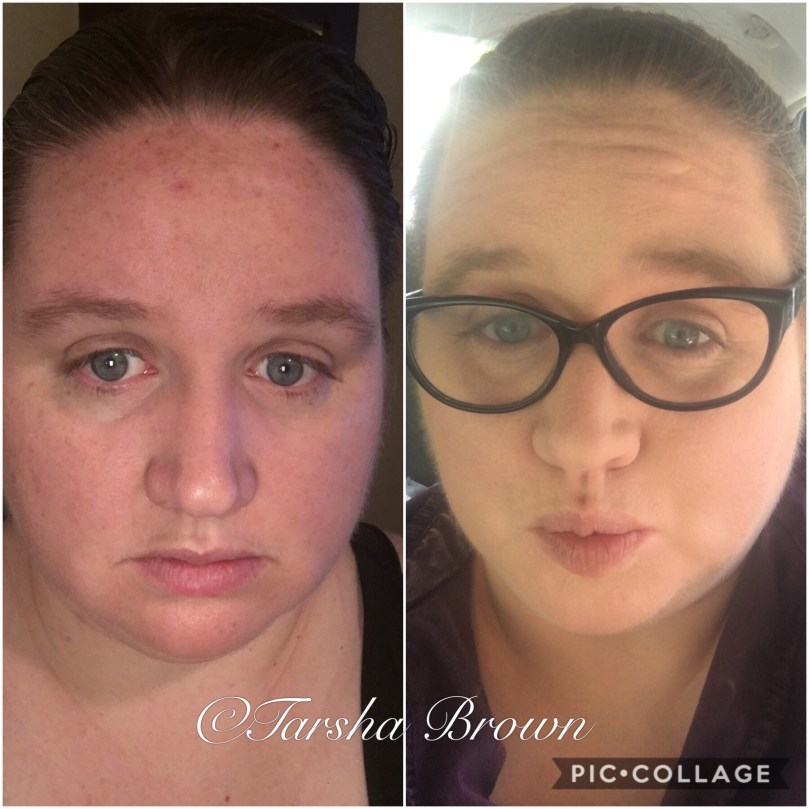
I tried to put on makeup on, it used to help pep me up but it didn’t work. I put on too much setting powder my foundation wouldn’t blend properly neither would my eyeshadow. I felt worse after putting it on. I looked like a puffy orange clown. My emotions are so raw they hurt and I can’t numb it and it is so raw that it is almost unbearable. We forget sometimes that through the memes, quotes that we desensitize our illness. We need to be more open about how much it hurts to be like this. I will update my progress through this as sober as possible.

🖤

🖤Day 9 🖤 Walking canvas (tattoos and piercings)

I will start with piercings because they aren’t as interesting. I had a tow hitch (belly button ring) I had it pierced 3 different times. My favorite was a piercing and tattoo place in the mall who only charged me $10. It got infected (surprised) and then the other 2 were at legit places but they pierced it too deep. (I have scars) I determined after that the chubby me shouldn’t have her belly button pierced. I’ve had my ears pierced many times but I forget to put earrings in and the holes closed.

Now the good stuff my tattoos. I was scared for the longest time until 2015 during my manic I decided to get a tattoo. Once you get one tattoo you have to get more right?

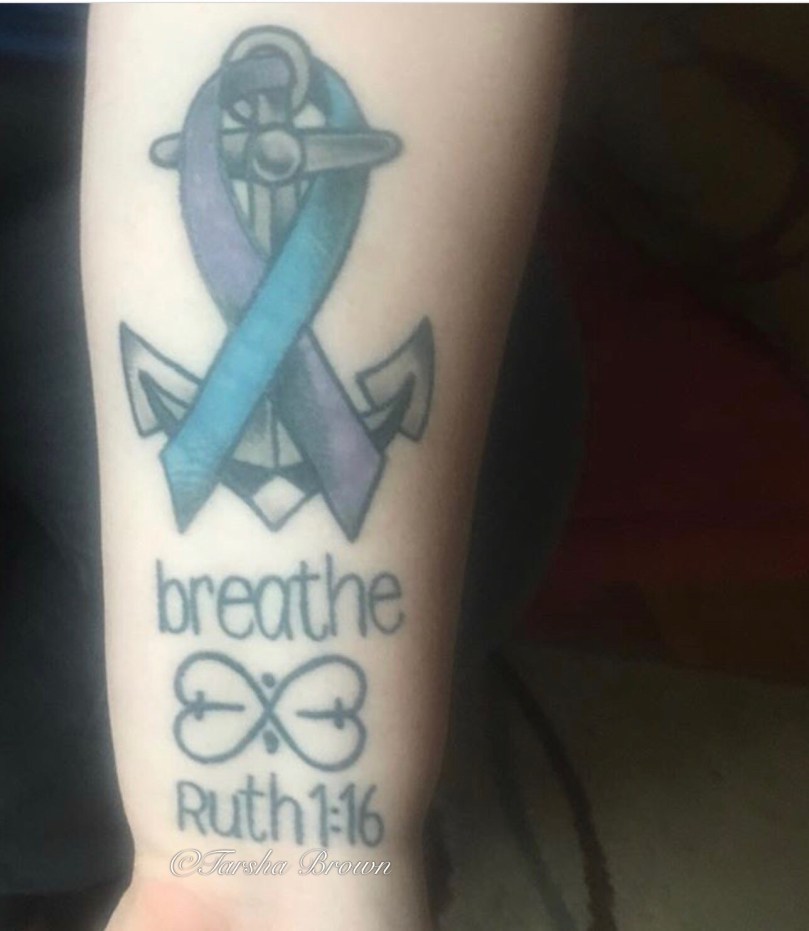
This is actually my first and second tattoo. My breathe tattoo was actually my first. I got it on my 31st Birthday. Of course breathe is for my anxiety, my semi colon for suicide, my infinity symbol and cross with Ruth 1:16 for my renewal and love of my faith. I love the fact that is my handwriting.

The second is the suicide awareness ribbon with my anchor. This was after a suicide attempt.

The most popular via Instagram reviews. The original version I found wasn’t this cool, but I have an amazing tattoo artist that made it beautiful. This is the man. If you’ve read any of my other post you know about the man. He wanted to detail the spine to show more vulnerability in the woman who is a slave to the man who controls her life.

I think neck tattoos are awesome and I also wear my hair up all the time so you can see it. This is in support to every fucked up thing that happened to me. I am a fighter and will continue fight until it wins one way or another. This was around the time I opened up about the terrible awful horrible thing that happened to me. This again is my handwriting. My cross on the T and my ; as the i is again my survival from this fucking disease
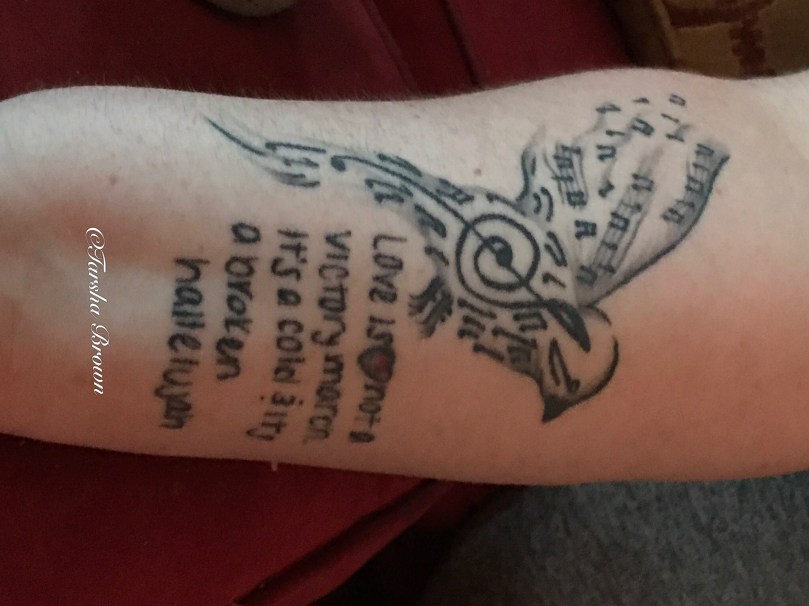


Music is my refuge which I know is the case for many people. I can play almost any instrument, make mash ups, my music list has an amazing range but I can’t sing. I wish I could sing but the sound of me screeching isn’t attractive. My mental health abilities did not bless me with the ability to sing. Hallelujah is my favorite song. I have saved between YouTube, Musi, Spotify I have so many different versions saved. This is the song I listen to when I start to spiral out of control. This tattoo is a just a base to the final half sleeve tattoo I want is finished.

My bipolar disorder. This is Sasha (check a new post for Sasha.) When I went in I asked for the mask that is black and white with a happy/sad painted across it. He said he wanted to try something different I said okay and this is what he came up with and I love it. It was an impulsive decisions which ironically fits the tattoo. This is a more modern version of that work. I wear this with great pride.

This honestly was just to be a dick. It is a stereotypical tattoo for mental health in my opinion but the size and placement was just to prove a point. I don’t regret it while it isn’t my favorite tattoo.

My artwork is just starting and I can’t wait to express my life across my arms. It shows the fight I am trying to win.

🖤

🖤Perks of being Bipolar 🖤

As I am writing this I’m standing in an open field under gray skies small pellets of water coating my arms. The smell of fair food, musty cologne fill the air, country music blaring through blown out speakers; my daughter is currently 10 ft in the air being thrusted into circles on swings. I bet you are wondering what the hell being at a fair as to do with the perks of being bipolar and how am I tending to my daughter at the same time. Bipolar perks people. If you weren’t aware your mental illness comes with perks other people don’t possess. I don’t know the exact medical terms for these but you will get my point.

🖤 Hyper-focus- the ability to hyper focus when used correctly can produce amazing results. I’ve abused my hyper focus when I was manic or self destructive behavior but over the last year or so I’ve learned to make it useful. It is almost becoming a super power. Is it still destructive? Absolutely! I am trying to keep it as a positive trait though. Think of the population who spends millions of dollars on herbal remedies and over the counter medicine to try and give them the ability you naturally have. We of course take medicine to control it but how amazing for us.

🖤 Disturbed cognitive functioning- Neil Hilborn (yes I named dropped because his slam poem The Future is incredible.) he touches on this saying They keep telling me seeing things that aren’t technically there is called “disturbed cognitive functioning.” I call it “having a superpower.” Once, I pulled over on the 110 freeway and jumped out of my old Jeep because I saw it burst into flames twenty seconds before it actually burst into flames.

🖤 (Idk the technical term for this) self awareness- A perk of having issues with paranoia is you are always self aware. I can walk into a room or a crowd and in less than a minute I’ve evaluated the entire situation. I can tell you who is standing around me without even looking up. My daughter is in line for a ride and I’ve already analyzed the line she’s in determined where an issue may be; the creepy ass guy to the right of me checking out teenage girls that I keep check on. People in the CIA and FBI are trained to have this ability and we naturally have it. Does my paranoia cause me problems? Of course, but when it comes to my daughter my heightened sense of awareness and paranoia comes in handy. The lights and music everywhere can overwhelm my senses but that’s when hyper focus comes to the rescue.

🖤 Creativity- This is a given. A fucked up wiring makes us see the beauty in things that other people aren’t able to enjoy

🖤 Energy- Always a positive and a negative but mostly negatives because high energy usually leads to mania.

🖤 Strength- we majority of the time can handle our shit and it takes courage to keep going. It’s a blessing and a curse to have this gift.

🖤DAY 2🖤 MENTAL HEALTH WEEK- DISSOCIATIVE IDENTITY DISORDER/MULTIPLE PERSONALITY DISORDER

Each day I will detail an illness. Some of them you’ve heard of some you haven’t but the most important thing is we recognize some of them. One illness is greater than the other just some for more information.

Dissociative identity disorder (previously known as multiple personality disorder) is thought to be a complex psychological condition that is likely caused by many factors, including severe trauma during early childhood (usually extreme, repetitive physical, sexual, or emotional abuse).

What Is Dissociative Identity Disorder?

Most of us have experienced mild dissociation, which is like daydreaming or getting lost in the moment while working on a project. However, dissociative identity disorder is a severe form of dissociation, a mental process which produces a lack of connection in a person’s thoughts, memories, feelings, actions, or sense of identity. Dissociative identity disorder is thought to stem from a combination of factors that may include trauma experienced by the person with the disorder. The dissociative aspect is thought to be a coping mechanism — the person literally dissociates himself from a situation or experience that’s too violent, traumatic, or painful to assimilate with his conscious self.

Is Dissociative Identity Disorder Real?

You may wonder if dissociative identity disorder is real. After all, understanding the development of multiple personalities is difficult, even for highly trained experts. The diagnosis itself remains controversial among mental health professionals, with some experts believing that it is really an “offshoot” phenomenon of another psychiatric problem, such as borderline personality disorder, or the product of profound difficulties in coping abilities or stresses related to how people form trusting emotional relationships with others.

Other types of dissociative disorders defined in the DSM-5, the main psychiatry manual used to classify mental illnesses, include dissociative amnesia (with “dissociative fugue” now being regarded as a subtype of dissociative amnesia rather than its own diagnosis), and depersonalization/derealization disorder.

What Are the Symptoms of Dissociative Identity Disorder?

Dissociative identity disorder is characterized by the presence of two or more distinct or split identities or personality states that continually have power over the person’s behavior. With dissociative identity disorder, there’s also an inability to recall key personal information that is too far-reaching to be explained as mere forgetfulness. With dissociative identity disorder, there are also highly distinct memory variations, which fluctuate with the person’s split personality.

The “alters” or different identities have their own age, sex, or race. Each has his or her own postures, gestures, and distinct way of talking. Sometimes the alters are imaginary people; sometimes they are animals. As each personality reveals itself and controls the individuals’ behavior and thoughts, it’s called “switching.” Switching can take seconds to minutes to days. When under hypnosis, the person’s different “alters” or identities may be very responsive to the therapist’s requests.

Along with the dissociation and multiple or split personalities, people with dissociative disorders may experience a number of other psychiatric problems, including symptoms:

• Depression

• Mood swings

• Suicidal tendencies

• Sleep disorders (insomnia, night terrors, and sleep walking)

• Anxiety, panic attacks, and phobias (flashbacks, reactions to stimuli or “triggers”)

• Alcohol and drug abuse

• Compulsions and rituals

• Psychotic-like symptoms (including auditory and visual hallucinations)

• Eating disorders

Other symptoms of dissociative identity disorder may include headache, amnesia, time loss, trances, and “out of body experiences.” Some people with dissociative disorders have a tendency toward self-persecution, self-sabotage, and even violence (both self-inflicted and outwardly directed). As an example, someone with dissociative identity disorder may find themselves doing things they wouldn’t normally do, such as speeding, reckless driving, or stealing money from their employer or friend, yet they feel they are being compelled to do it. Some describe this feeling as being a passenger in their body rather than the driver. In other words, they truly believe they have no choice.

What’s the Difference Between Dissociative Identity Disorder and Schizophrenia?

Schizophrenia and dissociative identity disorder are often confused, but they are very different.

Schizophrenia is a severe mental illness involving chronic (or recurrent) psychosis, characterized mainly by hearing or seeing things that aren’t real (hallucinations) and thinking or believing things with no basis in reality (delusions). Contrary to popular misconceptions, people with schizophrenia do not have multiple personalities. Delusions are the most common psychotic symptom in schizophrenia; hallucinations, particularly hearing voices, are apparent in about half to three quarters of people with the illness.

Suicide is a risk with both schizophrenia and dissociative identity disorder, although patients with multiple personalities have a history of suicide attempts more often than other psychiatric patients.

How Does Dissociation Change the Way a Person Experiences Life?

There are several main ways in which the psychological processes of dissociative identity disorder change the way a person experiences living, including the following:

• Depersonalization. This is a sense of being detached from one’s body and is often referred to as an “out-of-body” experience.

• Derealization. This is the feeling that the world is not real or looking foggy or far away.

• Amnesia. This is the failure to recall significant personal information that is so extensive it cannot be blamed on ordinary forgetfulness. There can also be micro-amnesias where the discussion engaged in is not remembered, or the content of a meaningful conversation is forgotten from one second to the next.

• Identity confusion or identity alteration. Both of these involve a sense of confusion about who a person is. An example of identity confusion is when a person has trouble defining the things that interest them in life, or their political or religious or social viewpoints, or their sexual orientation, or their professional ambitions. In addition to these apparent alterations, the person may experience distortions in time, place, and situation.

It is now acknowledged that these dissociated states are not fully mature personalities, but rather they represent a disjointed sense of identity. With the amnesia typically associated with dissociative identity disorder, different identity states remember different aspects of autobiographical information. There is usually a “host” personality within the individual, who identifies with the person’s real name. Ironically, the host personality is usually unaware of the presence of other personalities.

What Roles Do the Different Personalities Play?

The distinct personalities may serve diverse roles in helping the individual cope with life’s dilemmas. For instance, there’s an average of two to four personalities present when the patient is initially diagnosed. Then there’s an average of 13 to 15 personalities that can become known over the course of treatment. While unusual, there have been instances of dissociative identity disorder with more than 100 personalities. Environmental triggers or life events cause a sudden shift from one alter or personality to another.

Who Gets Dissociative Identity Disorder?

While the causes of dissociative identity disorder are still vague, research indicates that it is likely a psychological response to interpersonal and environmental stresses, particularly during early childhood years when emotional neglect or abuse may interfere with personality development. As many as 99% of individuals who develop dissociative disorders have recognized personal histories of recurring, overpowering, and often life-threatening disturbances at a sensitive developmental stage of childhood (usually before age 9). Dissociation may also happen when there has been persistent neglect or emotional abuse, even when there has been no overt physical or sexual abuse. Findings show that in families where parents are frightening and unpredictable, the children may become dissociative.

How Is Dissociative Identity Disorder Diagnosed?

Making the diagnosis of dissociative identity disorder takes time. It’s estimated that individuals with dissociative disorders have spent seven years in the mental health system prior to accurate diagnosis. This is common, because the list of symptoms that cause a person with a dissociative disorder to seek treatment is very similar to those of many other psychiatric diagnoses. In fact, many people who have dissociative disorders also have coexisting diagnoses of borderline or other personality disorders, depression, and anxiety.

The DSM-5 provides the following criteria to diagnose dissociative identity disorder:

1 Two or more distinct identities or personality states are present, each with its own relatively enduring pattern of perceiving, relating to, and thinking about the environment and self.

2 Amnesia must occur, defined as gaps in the recall of everyday events, important personal information, and/or traumatic events.

3 The person must be distressed by the disorder or have trouble functioning in one or more major life areas because of the disorder.

4 The disturbance is not part of normal cultural or religious practices.

5 The symptoms can not be due to the direct physiological effects of a substance (such as blackouts or chaotic behavior during alcohol intoxication) or a general medical condition (such as complex partial seizures).

Are There Famous People With Dissociative Identity Disorder?

Famous people with dissociative identity disorder include retired NFL star Herschel Walker, who says he’s struggled with dissociative identity disorder for years but has only been treated for the past eight years.

Walker recently published a book about his struggles with dissociative identity disorder, along with his suicide attempts. Walker talks about a feeling of disconnect from childhood to the professional leagues. To cope, he developed a tough personality that didn’t feel loneliness, one that was fearless and wanted to act out the anger he always suppressed. These “alters” could withstand the abuse he felt; other alters came to help him rise to national fame. Today, Walker realizes that these alternate personalities are part of dissociative identity disorder, which he was diagnosed with in adulthood.

How Common Is Dissociative Identity Disorder?

Statistics show the rate of dissociative identity disorder is .01% to 1% of the general population. Considering dissociation more broadly, more than a third of people say they feel as if they’re watching themselves in a movie at times (that is, possibly experiencing the phenomenon of dissociation), and 7% percent of the population may have some form of an undiagnosed dissociative disorder.

What’s the Recommended Treatment Plan for Dissociative Identity Disorder?

While there’s no “cure” for dissociative identity disorder, long-term treatment can be helpful, if the patient stays committed. Effective treatment includes talk therapy or psychotherapy, hypnotherapy, and adjunctive therapies such as art or movement therapy. There are no established medication treatments for dissociative identity disorder, making psychologically-based approaches the mainstay of therapy. Treatment of co-occurring disorders, such as depression or substance use disorders, is fundamental to overall improvement.

Because the symptoms of dissociative disorders often occur with other disorders, such as anxiety and depression, medicines to treat those co-occurring problems, if present, are sometimes used in addition to psychotherapy.

Source:

WebMD Medical Reference Reviewed by Joseph Goldberg, MD on May 11, 2018

My current medication regimen- popping pills like a pro

I have a long list of medications and if you’ve ever been diagnosed you know that finding the exact right combination of pills is sometimes similar as looking for a 4 leaf clover. Medication process if you are a lucky unicorn is painless, but it wasn’t that way for me. I made a list one time of all the medication I’ve been on not including the dosage changes. I found an amazing psychiatrist who talks to me about things going on in my life, mood changes, current feelings and between him and the nurse in the office they take great care of me. I think if your psychiatrist can tell when you are completely full of shit and lying for pills, to the times you aren’t being completely honest to avoid the hospital and he always can. My insurance won’t cover him which is tough sometimes but I don’t mind because he is worth it! He and I have an agreement I will try and be 100% honest and if he think psych is necessary we will discuss it in great detail before the decision is made. (In 2015 that wasn’t always the case.)

My medication at this very moment looks like this: Lamictal 400 mg – btw when they put you on Lamictal and tell you if you develop a rash to go straight to the ER because of what it can turn into is terrifying. Seroquel – 600 mg an antipsychotic but also helps me sleep, most of the time. Restoril- to help some with nightmares. I am so good at meds that I can tell you what most of them are and what they are used for. I can also tell you about any reactions from mixing the medication. I also know their government and brand names. I also have Nuvigil which I never take because it makes me feel weird sometimes I feel like a zombie and numb other times I feel nothing at all it just depends on what is going on. I take my medicine at 7:30 every night like clockwork. The alarm is set on my phone and I make sure I have it. I can’t skip or take less then prescribed. I know at some point my meds will have to be adjusted but I think I can handle it now. A word of advice NEVER STOP TAKING YOUR PILLS COLD TURKEY YOU IT CAN CAUSE A LOT OF PHYSICAL AND EMOTIONAL DAMAGE!!!!!!

Funny story- CVS handles my prescriptions because I have Caremark and if I ever have to go inside none of them want to talk to me. Why are you asking me what the generic name is and why are you asking me if you can fill it a day early? I don’t know can you fill it a day early? I don’t work in the pharmacy also when they call my prescription in (the office is an hour away from CVS) and they make it a point to tell me who they spoke with and when I get there and they say, “No one called us. We need to call them and confirm.” “No she just talked to you.” “It wasn’t me” “Yes it was I heard you say your name.” This will continue for a few minutes until the pharmacist comes over and tells me I’m wrong and then realizes I am right. There was also this woman, she didn’t last very long, would tell everyone “Wow that is a lot of medicine.” Yeah you really shouldn’t say that to people. I think she lasted a month and they fired her.

So this is my medicine story, What is yours?

🖤

Open Mic Night 2018

This year I wanted to do something different to raise money for the AFSP Out of the Darkness Walk. This year is my third year and I am so excited! I normally go on Facebook and give people long winded stories on why suicide prevention is so important and the hotline number. The plus side to all of this are the people who come up to me and feel comfortable enough to tell me their story. I want that communication with everyone, the event started out as an original content only but quickly changed to bring more people in. I tried selling tickets online (which if you do this please check the websites credibility first. You live and you learn. I managed to raise $500 in one night. $500 I had cozies (I still have some if anyone is interested) and charged $7.50 a ticket with free food. I was hoping for $200 and when we got the final total I cried. I cried for so many reasons but mostly I cried because in a little over 2 hours we educated over 50 people about suicide and mental health. If you are able to reach one person you are successful.

I got up and told my story. I don’t do well in front of people and not fond of eye contact so I stared at the mic and probably talked a little too fast but when I said “I tried to die by suicide a year ago on 9/27/18. It was like all the was sucked out of the room. I could feel the eyes staring through me and I knew this was it, the time I wanted so bad and even though I seem very comfortable discussing my illness on social media saying it out loud was a completely different story. I never told the true story on my Facebook page but when I finished and walked away from the mic still shaking I was met with hugs, I love you’s, I didn’t know how bad it was, and please call me if you ever need anything. It was more support I expected but I welcomed it all. I never thought my words could have so much power. Which is why I started this blog and these social media sites, I wanted to spread my word and make a difference. I would quote Gandhi but his views about rape make me question his morales. I have attached some pics of the open night mic cozies and my centerpieces that turned out beautiful.

🖤